
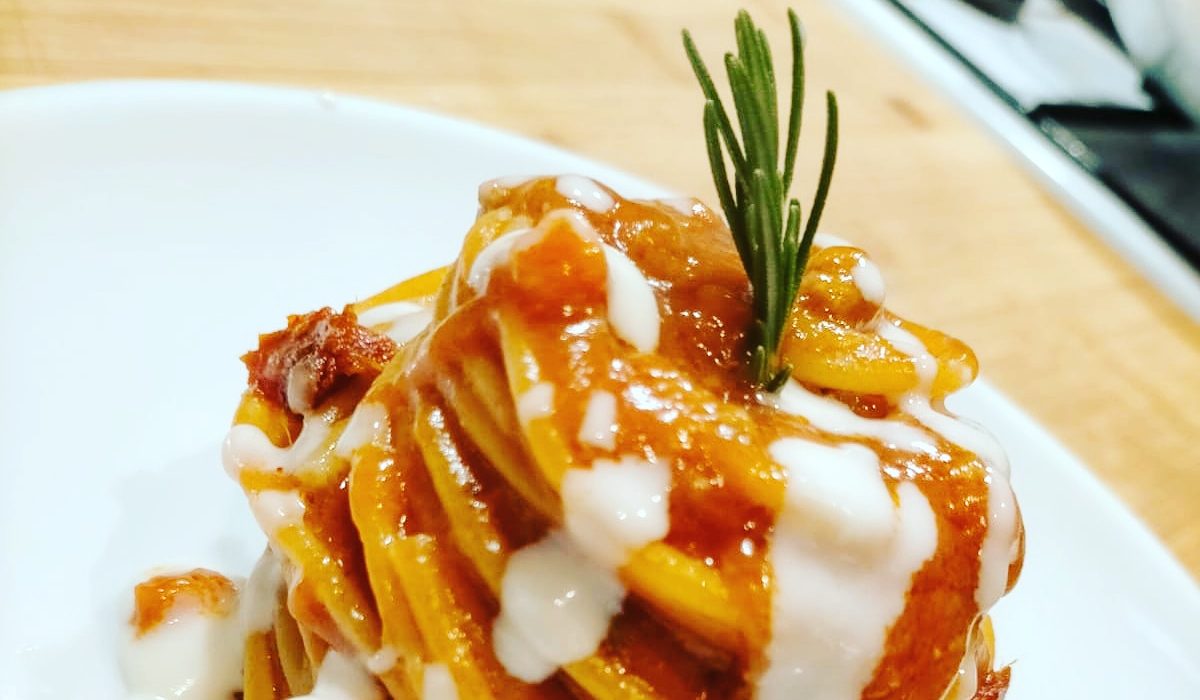

Many people think pasta is just flour and eggs, something simple that you cook in a few minutes. But when you work in a real pasta factory, you understand that pasta is a craft, a tradition, and a skill that takes years to learn.
I had the opportunity to work in a pasta factory where fresh pasta is produced every day. This experience taught me not only how to make pasta, but also how much work, precision, and passion there is behind every plate of ravioli, tagliatelle, or spaghetti.
The person who taught me and is still teaching me today is Chef Adam Hudson, an English chef with a great passion for Italian fresh pasta. It may sound strange that an English chef teaches Italian pasta, but passion has no nationality, and when someone really loves pasta, you can see it in the way they work the dough, the sfoglia, and every single shape of pasta.

Chef Giorgio & Chef Adam
We often work together as a team, almost always side by side, dividing the tasks. Usually he prepares the dough and the pasta sheets, while I prepare the fillings for the ravioli. Meat fillings, ricotta and spinach, vegetables, potatoes, or seasonal ingredients. But during the day we often switch roles, so sometimes I work the dough and he prepares the fillings. This is how some of our best creations are born, working “four hands”, sharing ideas, techniques, and experience.
Working this way is very important because you never stop learning. Every dough is different, every flour reacts differently, humidity changes the pasta, and experience teaches you how to adjust everything. Pasta is alive, and you must understand it, not just follow a recipe.
In a pasta factory, the day starts very early, often at dawn. When most people are still sleeping, we are already in the laboratory preparing flour, eggs, and machines for the day. The morning is the most important moment because this is when the pasta is born.
The first job is always the same: making the dough and preparing the sfoglia. Flour and eggs are mixed and kneaded until the dough becomes smooth and elastic. Then the dough rests, and after that we start passing it through the rollers to create long sheets of pasta. This moment is always special, because from a simple piece of dough, many different types of pasta will be created.
From the sfoglia we make tagliatelle, pappardelle, lasagne, and of course ravioli. At the same time, using different machines, spaghetti and other pasta shapes are produced. Seeing the spaghetti coming out of the machine is always fascinating, because it really feels like watching pasta being born.
Ravioli are another important part of the morning work. While one of us prepares the pasta sheets, the other prepares the fillings. Then we work together to close the ravioli carefully, making sure they are perfectly sealed. This is a very precise job, because if ravioli are not closed well, they will open during cooking.
Every morning is similar but also different, because flour changes, humidity changes, and the dough behaves differently every day. This is why making fresh pasta is not just following a recipe, but understanding the dough and working with it every day.
If you want to try making fresh pasta at home, there is a very simple traditional rule in Italy: 1 egg for every 100 grams of flour. You can use semolina flour or 00 flour. Put the flour on the table, make a hole in the center, add the eggs, and start mixing with a fork. Then knead the dough by hand for about 10 minutes until it becomes smooth and elastic. Let it rest for about 20–30 minutes, then roll it with a rolling pin or a pasta machine and you can make tagliatelle, ravioli, or lasagna.

Working in a pasta factory taught me that pasta is not just food. It is technique, patience, mistakes, learning, and teamwork. And sometimes the best pasta is not made by one person, but by two people working together, four hands on the same dough.